

The goal of this series (“complexities”) is simple: to get you to think more deeply about “human problems.”
We have all heard the cliché, “it takes two to tango” or “it takes two to have an argument.” Yet, when it comes to teaching leadership, the industry is obsessed with how we present ourselves. We are told how to talk, how to gesture, how to “stop saying um,” and how to exude confidence. But we almost never talk about what the other party is actually thinking or experiencing. Why? Because that requires real psychological effort, and most people don’t like hard work.
Psychologists have a term for this: a High Need for Cognitive Closure. It means people prefer quick, clean, black-and-white answers over ambiguity.
But the reality is that the world we live in is far more messy and nuanced than a checklist of “have courage” or “raise your voice.” Corporate coaches and self-help gurus love to make you look inward, forcing you to focus entirely on yourself. If you want to actually solve systemic problems, you have to look outward. You need to learn to think about others, decode what they are experiencing, and navigate the hidden dynamics around you.
Let’s start with courage.
”Courage” the Leadership Mantra
Anyone who has read any self-help or career growth book, attended any sort of leadership talk, or has studied any degree of Agile, has stumbled upon “Courage”.
My issue with “courage” is that it has turned into a corporate buzzword. How many corporate drones, alpha males, girl boss and entrepreneur types have you heard say “You need to have courage.” and you genuinely thought to yourself “Yes, this is advice comming from someone I generaly see as a courageous person.” The reality is many individuals say the mantra but do not necessarily know what it means.
We instinctively know what courage is—the hero in the face of adversity who rises to the challenge, someone who risks their lives for the greater good. We all know the kind.
I would personally define courage as:
“Making difficult decisions in the face of adversity.”
But what does courage within leadership look like? Many will say something along the lines of “Ability to speak the truth, stick to your ideas, and not back down.”
Notice how there is something missing from that definition?
- What is the adversity?
- Back down from what?
- Why is it that even with family members or close friends you would take a bullet for, you still need to be courageous to speak up?
If you do not understand what you are supposed to be courageous against, you do not know how it actually looks like to be courageous in the first place.
The Adversary: Human Nature
Humans by nature do what they can to evade conflict. It is in our very nature—maybe some of you just scoffed at the idea, but it is true.
For example, how many of you like being the one to deliver bad news?
- “Oh man, I cannot wait to tell my boss we just lost $50 million!”
- “When my wife asks if the dress looks good on her, I’ll definitely tell her it looks hideous.”
- “I’ll tell my husband to stop with his jokes, they are terrible and awkward.”
Even if it comes to the need to share these things, we try to lower the blow and “sugarcoat” things.

We all know that being the one to point to the Emperor and say “that man is naked”—the one that addresses the “elephant in the room”—means you will get in trouble or at minimum people will react negatively towards you.
But aren’t they being “courageous”? Why not celebrate that someone finally said something about it?
The Evolutionary Cost of Speaking Up
Because historically, going against what the larger group thinks meant you could be left behind by the tribe to die off in some jungle alone.
Studies have shown how the amygdala triggers a fight-or-flight response at social rejection. Think about it: being rejected makes you feel the exact same level of emotional pain as being faced by a hungry lion.
It is not a fun feeling, and so we fear it. Just how you fear a lion and do not dare to jump into its den, you fear rejection so you do not wish to place yourself in a position to be rejected.
Neuroimaging studies show that when a person experiences social rejection or isolation, the brain lights up in the anterior cingulate cortex—the exact same region that processes physical pain. To your neural wiring, being dogpiled, excluded, or cast out by your peers feels like an actual physical threat.
When processing information, the human brain performs a dual calculation:
- What is the factual truth of this statement?
- What will happen to my social status if I say it out loud?
For the majority of people, if the answer to that second question is “social ruin,” the brain triggers a defense mechanism known as identity-protective cognition. Your brain will actively distort its own perception of reality just to align with the tribe. It is not a fun feeling, and so we fear it. Just how you fear a lion and do not dare to jump into its den, you fear social ruin so intensely that your brain would rather alter the truth than risk placement in a position to be rejected.
Your brain struggles to differentiate between a physical threat and a social threat. To your amygdala, public humiliation and a predator look exactly the same.
Interestingly, this survival fear can be completely overwritten by an immediate, physical sense of danger.
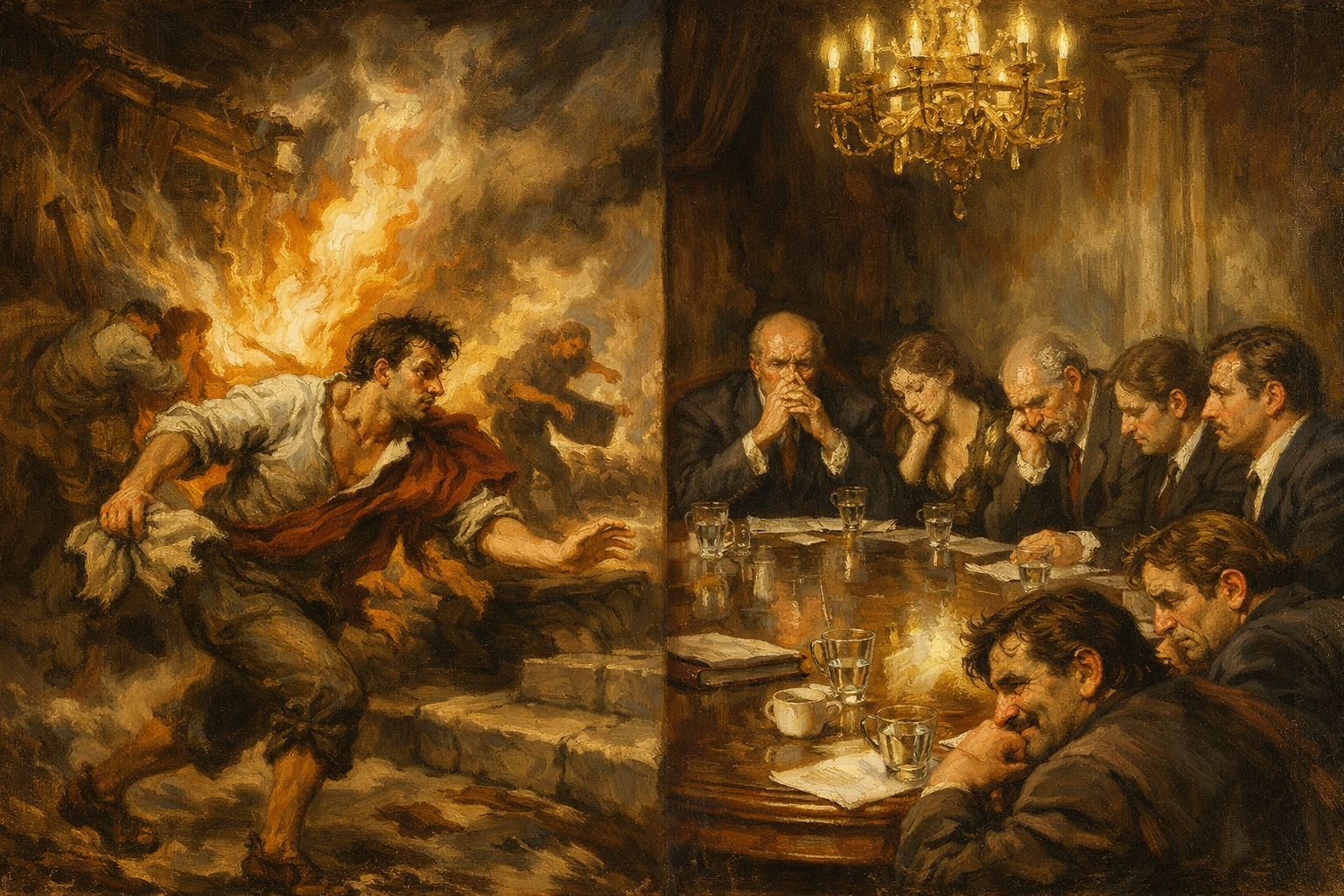
We are not going to have fear addressing the elephant in the room when the elephant is a room caught on fire, or a bleeding person right in front of us. In those moments, the physical threat is obvious and immediate.
But a broken business process, a bad design choice, or a terrible management decision? That is a social threat, and our evolution tells us to freeze, conform, and stay quiet to keep our spot in the tribe.
That is to say, do not wait for the situation to turn into a mess before taking action.
(Or of course start having boardmeetings in a room full of snakes. [Note this is a joke, and I will not be liable for any snake bites.])
The Psychology of the Silent Room
When a team sits around a table ignoring a glaring issue, two distinct psychological traps are usually at play. Understanding them helps tie our instinct to run from conflict directly to our corporate behavior.
First, there is the Ignore Part: this is driven by a phenomenon called Pluralistic Ignorance. This happens when everyone in the room privately thinks a project is headed for disaster, but because nobody else is saying anything, everyone assumes they must be the only one who thinks that way. So, you keep your mouth shut, thinking your doubts are just a personal error.
Second, there is the Pretend Everything is Fine Part: this is known as the Abilene Paradox. This is where a group collectively decides on a course of action that no individual member actually wants, simply because each person mistakenly believes it’s what everyone else wants. You smile, nod, and agree to stay late working on a terrible feature, assuming you’re just “being a team player,” while the person next to you is doing the exact same thing for the exact same reason.
The Japanese 和 (“Wa”)
This instinctual drive to keep the peace at all costs is not just an individual flaw; it is often embedded deeply into our cultures. Take the Japanese concept of Wa (和), which translates to “harmony.”

In its best sense, Wa represents a beautiful cultural value of mutual respect, teamwork, and community balance. But there is a flip side to it.
When corporate or social environments prioritize Wa above all else, it morphs into intense peer pressure (Dōchō atsuryoku / 同調圧力). Dissenting voices are actively silenced, and pointing out flaws is seen as ruining the harmony of the group.
When we value a false sense of peace over reality, we end up participating in a corporate version of Wa—staying silent just to keep the boat from rocking, even when we can clearly see the boat is steering directly into an iceberg.
My Advice
Having discussed everything, what do we do about it? How do we weigh the immediate fear of speaking up against the long-term cost of staying silent?
- Invoke self-reflection and curiosity: Before you rush to shoot down a bad idea, ask yourself what you are protecting. Instead of being confrontational and saying, “This plan is terrible,” reframe your courage through curiosity. Ask: “I have some edge-case concerns about this timeline; can we walk through how we handle a delay?” It takes the target off your back while still forcing the truth into light.
- Understand power dynamics: Courage without tactfulness or wisdom is just foolery, it doesn’t matter how right you are. Choose your battles correctly. If you scream truth to power without navigating the environment, you aren’t being a hero—you’re just being reckless.
- Calculate the cost of the future: When your amygdala screams at you to stay quiet, it is only calculating the immediate discomfort of a tough conversation. Force yourself to look at the long-term cost of staying silent. What happens if you let this bad code ship? What is the cost to your sanity if you stay quiet for another six months? Sometimes, future pain is way worse than immediate friction.
- Set clear boundaries for when you must speak: You cannot fight every battle, or you’ll get branded as the company contrarian. Decide in advance what your “burning room” thresholds are. If a decision crosses an ethical line, guarantees a project failure, or hurts a teammate, that is your trigger to speak. If it’s just a minor design preference, let it go.
- Allow for failure: Sometimes it is better to simply stay quiet and let things play out. The best way for a kid to learn the stove will burn them is, sadly, getting burned. This holds true for adults and organizations. It is sometimes necessary to allow people to fail so they can actually learn. Just try not to fall into the “I told you so” trap afterward—that is never constructive.